
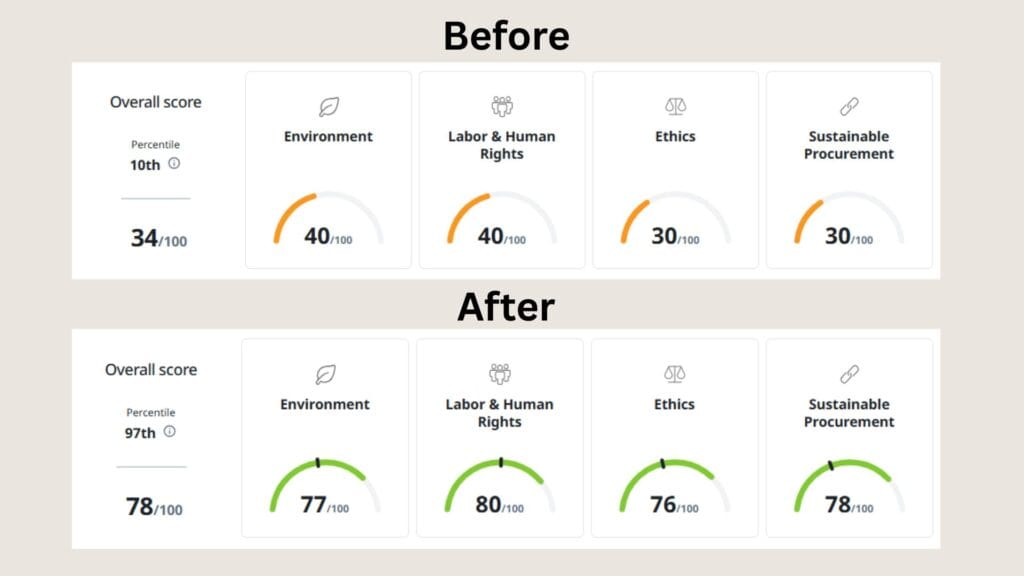
How to Improve Your EcoVadis Score Fast (Without Cutting orners)If your company has received an EcoVadis assessment result that’s lower than expected, or if a key customer has asked you to reach a specific EcoVadis rating quickly, you’re probably wondering: can you actually improve your EcoVadis score fast, and if so, how?
The short answer is yes, meaningful EcoVadis score improvement is possible within a relatively short timeframe for many companies. But “fast” doesn’t mean overnight, and it doesn’t mean taking shortcuts that will backfire in future assessments.
This guide explains what realistic fast improvement looks like in the EcoVadis system, the practical EcoVadis quick wins that deliver genuine results, and how to achieve visible progress without compromising the integrity of your sustainability performance. Whether you’re in Europe, North America, Australia, or New Zealand, these principles apply to businesses of all sizes seeking to strengthen their supplier sustainability credentials.
Understanding What EcoVadis Actually Measures
Before diving into improvement strategies, it’s essential to understand what drives your EcoVadis rating. EcoVadis evaluates companies across four key themes: Environment, Labour and Human Rights, Ethics, and Sustainable Procurement. The specific questions and weighting depend on your company size, sector, and location.
The assessment methodology focuses on two main dimensions. First, it examines your policies, commitments, and management systems. Do you have appropriate frameworks in place to manage sustainability topics relevant to your business? Second, it evaluates implementation and results. Can you demonstrate that you’re actually putting those policies into practice and measuring outcomes?
EcoVadis scoring isn’t about perfection. It’s about demonstrating credible, systematic approaches to managing sustainability risks and impacts that are material to your business. This structure creates real opportunities for fast improvement because many companies already have practices in place but struggle to present them effectively to EcoVadis assessors.
What “Fast Improvement” Really Means in EcoVadis
When we talk about improving your EcoVadis score fast, we’re typically looking at a timeframe of three to six months to implement improvements and prepare for reassessment. Some companies see meaningful score increases in as little as 60 to 90 days when the right gaps are identified and addressed.
Fast improvement doesn’t mean fabricating systems that don’t exist or submitting misleading documentation. It means identifying where you already have decent practices but poor documentation, where simple process formalisation can close scoring gaps, and where targeted improvements deliver disproportionate assessment impact.
The companies that achieve the fastest legitimate improvements typically fall into one of these categories. They have sustainability practices in place but haven’t documented them properly for EcoVadis assessment requirements. They have policies but can’t demonstrate implementation through evidence and monitoring. They’re addressing the wrong topics or providing irrelevant documentation that doesn’t align with their materiality profile. Or they have documentation gaps in specific high-impact areas that, once filled, significantly improve their overall rating.
If your company fits any of these descriptions, substantial EcoVadis score improvement in a short timeframe is absolutely achievable.
Quick Win 1: Structure and Formalise Existing Practices
Many companies, particularly SMEs and mid-sized businesses, operate with effective sustainability practices that simply aren’t formalised or documented. You might have strong health and safety procedures, fair employment practices, or environmental controls, but nothing written down in a way EcoVadis assessors can evaluate.
This gap represents one of the fastest paths to score improvement. Taking existing practices and creating structured documentation around them doesn’t require changing how you operate. It requires capturing what you already do in clear, accessible formats.
For example, if your operations team conducts regular safety inspections but uses informal checklists and verbal communication, creating a formal inspection procedure with documented results immediately strengthens your health and safety evidence. If you’ve been selecting suppliers based on quality and reliability considerations that include labour and environmental factors, documenting this as a formal sustainable procurement procedure creates assessment value.
The key is authenticity. You’re not inventing practices you don’t have. You’re giving structure and visibility to things you genuinely do, making them accessible to external assessment.
Action steps for this quick win:
- Identify informal practices that address EcoVadis topics
- Document them in simple, clear procedures or policy statements
- Ensure documentation includes who’s responsible, what activities occur, and how often
- Gather evidence that these practices actually happen, such as meeting notes, inspection records, or training attendance
Quick Win 2: Close Critical Documentation Gaps
EcoVadis assessment requires specific types of documentation to score in various areas. Missing just one or two critical documents can significantly impact your overall rating, while adding them delivers immediate improvement.
Common high-impact documentation gaps include having no written Code of Conduct or business ethics policy, lacking a formal environmental policy even though you manage environmental impacts, missing health and safety policies despite having practical safety measures, having no documented approach to sustainable procurement or supplier assessment, or lacking evidence of employee training on policies you’ve created.
Closing these gaps doesn’t mean creating elaborate 50-page documents. A concise, clear policy that genuinely reflects your company’s commitments and approach is more valuable than lengthy generic statements.
For instance, if you’re a trading company with limited direct environmental impact, a focused environmental policy addressing your material issues like transportation efficiency, packaging waste, and energy use in offices is appropriate and scores well. It doesn’t need to cover industrial emissions or water management if those aren’t relevant to your operations.
Action steps for this quick win:
- Review your previous EcoVadis feedback to identify which policy areas scored low or zero due to missing documentation
- Create targeted, relevant policies for your highest-impact gaps
- Ensure new policies are approved by appropriate management levels
- Link policies to practical implementation, even if simple
Quick Win 3: Improve Evidence Quality and Specificity
Many companies submit evidence to EcoVadis that’s too vague, incomplete, or doesn’t clearly demonstrate what assessors need to see. Improving evidence quality can boost scores substantially without requiring operational changes.
Poor evidence might look like submitting a supplier code of conduct when asked about supplier sustainability assessment practices, without showing how you actually use it. Or providing energy consumption totals without context about monitoring frequency, improvement targets, or responsible personnel. Or uploading training materials without attendance records showing that training actually occurred.
Better evidence is specific, measurable, and clearly connected to the question being asked. If EcoVadis asks about environmental monitoring, strong evidence includes regular monitoring reports showing what you measure, how often, who’s responsible, and what actions you take based on results. If they ask about labour practices, strong evidence includes employment contracts, training records, and documentation of how you ensure compliance with labour standards.
The transformation from weak to strong evidence often doesn’t require doing more work operationally. It requires presenting what you already do more clearly and completely.
Action steps for this quick win:
- Review each piece of evidence you previously submitted and ask: does this clearly prove what the assessor needs to know?
- Add context to raw data through cover notes, explanations, or annotations
- Include dates, responsible parties, and frequency information
- Connect evidence directly to relevant policies and procedures
Quick Win 4: Demonstrate Governance and Responsibility Assignment
EcoVadis places significant weight on governance structures. Who’s responsible for sustainability topics in your organisation? How does management oversee and review performance? Are there clear accountability lines?
Many companies have people managing relevant areas, operations managers handling environmental compliance, HR managing labour practices, procurement managing suppliers, but haven’t clearly designated and documented sustainability governance. Creating this clarity is a fast win with substantial scoring impact.
This doesn’t require hiring a sustainability manager or creating a new department. It means formally assigning existing managers responsibility for relevant sustainability areas, documenting reporting lines, and showing that leadership reviews sustainability performance periodically.
A simple governance structure might designate your operations manager as responsible for environmental compliance, HR director for labour and human rights, and CEO for ethics oversight. Quarterly management meetings that include reviewing key sustainability metrics, even briefly, demonstrate governance in action.
Action steps for this quick win:
- Create an organisational chart or responsibility matrix showing who manages each sustainability theme
- Document management review processes, even if informal currently
- Show evidence of leadership engagement through meeting minutes, approvals, or directives
- Clarify escalation paths for sustainability issues
Quick Win 5: Set Targets and Track Progress
EcoVadis assesses whether you’re measuring performance and pursuing improvement, not just maintaining policies. Companies often lose points because they can’t demonstrate that they track metrics or set improvement objectives.
Adding measurement and targets to existing practices can significantly improve scores. If you already manage energy consumption, start formally tracking monthly usage and set a reduction target. If you conduct safety training, track completion rates and set coverage goals. If you engage suppliers on sustainability, establish metrics for how many suppliers you’ve assessed.
These targets don’t need to be aggressive or public. They need to be realistic, documented, and genuinely guide your improvement efforts. Even modest targets with visible progress score better than no targets at all.
Action steps for this quick win:
- Identify three to five key sustainability metrics relevant to your business
- Establish baseline measurements for current performance
- Set realistic improvement targets with timeframes
- Create simple tracking mechanisms to monitor progress
- Document how you review progress and adjust actions
Quick Win 6: Strengthen Implementation Evidence for Existing Policies
Having policies is important, but EcoVadis wants to see that those policies translate into action. Many companies have adequate policies but weak implementation evidence, creating an easy improvement opportunity.
Implementation evidence includes training records showing employees know about and understand policies, audit or inspection results demonstrating compliance checking, corrective action records showing how you address issues when found, performance data indicating measurement and monitoring, and examples of practical application such as supplier assessments, incident responses, or improvement projects.
If you have a strong anti-corruption policy but no evidence that employees are trained on it or that you’ve ever assessed corruption risks in operations, your score will be limited. Adding annual ethics training and documenting a simple corruption risk assessment process transforms that policy from words into demonstrated practice.
Action steps for this quick win:
- For each major policy, identify what implementation evidence you currently have
- Create or improve training programs with documented completion
- Establish simple audit or review processes to check compliance
- Document corrective actions taken when issues arise
- Collect performance data that shows the policy is working
Quick Win 7: Focus on Material Issues for Your Sector
EcoVadis tailors questions based on your industry and risk profile. Understanding which topics matter most for your specific sector helps you prioritise improvement efforts for maximum scoring impact.
A technology company should focus heavily on labour practices, data security, and ethics in their supply chain. A logistics company needs strong environmental practices around fleet emissions and fuel management. A professional services firm should emphasise employee wellbeing, diversity, and ethical business conduct.
Many companies waste effort addressing topics that aren’t material to their operations while neglecting areas that carry higher scoring weight. Realigning focus to your material issues delivers faster, more substantial improvement.
Action steps for this quick win:
- Review which EcoVadis themes and topics carried the most weight in your last assessment
- Understand common sustainability risks and priorities in your sector
- Prioritise improvements in high-materiality areas
- Ensure documentation addresses your specific business context rather than generic sustainability
What Not to Do When Seeking Fast Improvement
While there are many legitimate ways to improve your EcoVadis score quickly, certain approaches will backfire and should be avoided completely.
Don’t copy generic policies from the internet without customising them to your business. Assessors easily identify template documents that don’t match your actual operations. Don’t backdate documents to make it appear you had systems in place earlier than you actually did. This creates serious credibility and compliance risks. Don’t submit evidence for practices you don’t actually implement. The disconnect between stated policies and reality becomes obvious, especially in reassessments or customer audits.
Don’t ignore EcoVadis feedback from previous assessments. The feedback report tells you exactly where you lost points and what improvements would help. Not addressing this specific guidance means repeating the same mistakes. Don’t focus solely on documentation while ignoring actual practice improvements. EcoVadis increasingly requests verification evidence and on-site validation for higher scores.
The most successful fast improvements combine better documentation of existing practices with targeted operational enhancements in high-impact areas. This approach delivers immediate score gains while building toward sustainable long-term performance.
Linking Fast Improvements to Long-Term Systems
The EcoVadis quick wins described above deliver visible score improvement relatively quickly, but they shouldn’t be viewed as one-time fixes. The most valuable approach connects these rapid improvements to building sustainable management systems that support ongoing performance.
When you formalise existing practices, use that documentation to strengthen future consistency. When you close documentation gaps, ensure those new policies become working documents that guide decisions. When you improve evidence quality, establish regular processes for collecting and maintaining that evidence. When you set targets, create review mechanisms to track progress and adjust strategies.
This progression from fast fixes to embedded systems ensures your score improvements are sustainable through future reassessments. It also delivers the broader business benefits of effective sustainability management, including risk reduction, efficiency gains, and stronger stakeholder relationships.
Companies that treat EcoVadis as an ongoing performance management tool rather than a periodic assessment exercise consistently achieve higher ratings with less stress. The infrastructure you build while pursuing fast improvements becomes the foundation for continuous progress.
Realistic Timeframes for EcoVadis Score Improvement
Understanding realistic timeframes helps set appropriate expectations and plan effective improvement programs. Here’s what’s typically achievable for companies starting from different baseline scores.
Bronze to Silver: This improvement often takes 60 to 90 days for companies with basic practices in place but poor documentation. The focus is on closing critical policy gaps, improving evidence quality, and demonstrating basic governance.
Silver to Gold: Moving into Gold typically requires three to six months and involves not just better documentation but demonstrating stronger implementation, measurement, and improvement processes. You need more robust evidence of systematic management and performance tracking.
Gold to Platinum: Reaching Platinum generally takes six months to a year and requires demonstrating advanced practices, strong performance data, external verification, and continuous improvement over multiple assessment cycles. This level isn’t about quick wins but sustained excellence.
These timeframes assume focused effort with appropriate expertise. Companies working with experienced EcoVadis consultancy support typically progress faster than those navigating assessment requirements independently.
The Role of Professional EcoVadis Consultancy
While many improvement actions are conceptually straightforward, executing them effectively requires understanding EcoVadis assessment methodology, knowing what evidence assessors look for, recognising which improvements deliver the highest scoring impact, and avoiding approaches that seem helpful but actually waste time or create problems.
Professional EcoVadis consultancy brings this expertise, helping you identify your highest-priority improvement opportunities quickly, develop appropriate documentation that reflects your actual practices, gather and present evidence effectively, avoid common mistakes that delay progress, and build sustainable systems that support ongoing performance.
Good consultants don’t just manage your assessment submission. They build your internal capability to maintain and improve EcoVadis performance independently over time. This investment delivers returns across multiple assessment cycles and supports broader ESG performance improvement.
The consultancy approach should be collaborative, working with your team to understand current practices, identify authentic improvement opportunities, and implement changes that strengthen both your EcoVadis rating and actual sustainability performance. This ensures improvements are genuine, sustainable, and valuable beyond the assessment context.
Building Your Fast Improvement Action Plan
If you’re ready to pursue rapid EcoVadis score improvement, here’s a practical approach to get started.
Week 1-2: Assessment and prioritisation. Review your most recent EcoVadis scorecard and feedback thoroughly. Identify which specific questions or topics lost the most points. Understand which sustainability themes matter most for your sector and risk profile. Prioritise the three to five areas where improvement would have the greatest scoring impact.
Week 3-4: Documentation development. Create or enhance policies and procedures to address your priority gaps. Focus on clarity, relevance to your business, and authenticity. Ensure appropriate management approval of new or updated policies.
Week 5-6: Evidence gathering. Collect or create evidence demonstrating that your policies are implemented. This includes training records, monitoring data, audit results, meeting minutes, and performance metrics. Organise evidence clearly with context and dates.
Week 7-8: Governance and targets. Document your sustainability governance structure showing responsibilities and oversight. Establish measurement systems and improvement targets for key areas. Create evidence of management review and decision-making on sustainability topics.
Week 9-12: Refinement and submission. Review all documentation and evidence for quality, completeness, and alignment with EcoVadis requirements. Address any remaining gaps. Submit your reassessment request with improved materials. Use this period to strengthen any weak areas identified during review.
This 12-week framework is aggressive but achievable for motivated companies with adequate resources. Some organisations move faster, others need more time depending on starting point and internal capacity.
Measuring Success Beyond the Score
While achieving a higher EcoVadis rating is the immediate goal, the real success of fast improvement efforts should be measured by whether you’ve built capabilities that sustain and enhance performance over time.
Ask yourself: have we formalised practices that make operations more consistent and controllable? Have we improved visibility into sustainability risks and performance? Have we strengthened our ability to respond to customer ESG requirements? Have we built systems that make future EcoVadis assessments easier rather than harder?
If the answer to these questions is yes, your fast improvement approach has delivered lasting value. The score increase is a reflection of genuine enhancement to your sustainability management, not just better presentation of unchanged practices.
This perspective ensures that pursuing rapid EcoVadis score improvement aligns with broader business objectives around risk management, operational excellence, and stakeholder relationship strength.
Ready to Improve Your EcoVadis Score Quickly and Effectively?
Improving your EcoVadis rating doesn’t require months of delays or massive operational overhauls. With focused effort on the right priorities, most companies can achieve meaningful score improvement within three to six months while building sustainable systems for ongoing performance.
The key is knowing where to focus, understanding what evidence assessors need, and connecting rapid documentation improvements to genuine management systems. This approach delivers fast results that hold up in reassessments and customer due diligence.
I specialise in helping companies across all sectors and regions achieve rapid, credible EcoVadis score improvement. I work with businesses in Europe, the United States, Canada, Australia, and New Zealand to identify quick wins, develop appropriate documentation, gather compelling evidence, and build long-term sustainability capabilities.
Whether you need to reach a specific EcoVadis rating quickly to meet customer requirements or want to strengthen your supplier sustainability credentials strategically, I provide expert guidance that delivers results while maintaining integrity and building lasting value.
Ready to start your fast improvement journey? Home to learn more about our approach, explore our services to see how we support ethical, effective score improvement, or contact to discuss your specific timeline, goals, and challenges.
Your EcoVadis rating can improve significantly in the coming months. Let’s work together to make it happen the right way, with results that strengthen your business and satisfy your stakeholders for years to come.